


Dr. Chris Napier
Advancing Running Biomechanics Through Motion Capture and The MotionMonitor
Dr. Chris Napier, PT, PhD, is the Director of the SFU Run Lab at Simon Fraser University, where he leads innovative research focused on running biomechanics, injury prevention, and performance optimization. With a background that bridges clinical practice and biomechanical science, Napier uses advanced motion capture technology to better understand how athletes move and how movement-related injuries develop.
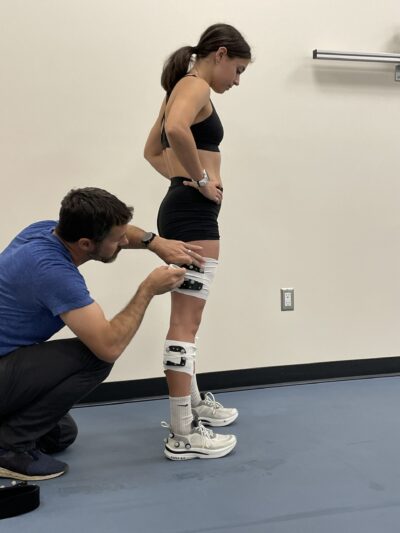
At the core of the Run Lab’s biomechanical workflow is The MotionMonitor, which Napier and his team use to capture, synchronize, and analyze complex human movement data.
Using The MotionMonitor for Advanced Motion Capture
The SFU Run Lab employs The MotionMonitor to support three-dimensional motion capture, enabling precise measurement of joint kinematics, segment motion, and dynamic movement patterns during running and functional tasks. By integrating motion capture data with force and sensor inputs, The MotionMonitor provides a comprehensive platform for quantifying biomechanical loading and movement strategies in a controlled laboratory environment.
This approach allows Napier’s team to conduct high-fidelity gait analyses that support research into injury mechanisms, running techniques, and movement variability across different populations.
Integrating Wearables with MotionMonitor Analysis
In addition to traditional lab-based motion capture, Napier’s research explores the use of wearable technologies such as inertial measurement units (IMUs) and soft strain sensors. The MotionMonitor serves as a reference and validation tool, enabling direct comparison between laboratory-grade motion capture and wearable data collected in real-world running environments.
By leveraging The MotionMonitor’s flexible data integration and biomechanical modeling capabilities, the Run Lab bridges the gap between controlled motion analysis and field-based assessment — a critical step in translating biomechanics research into practical applications.
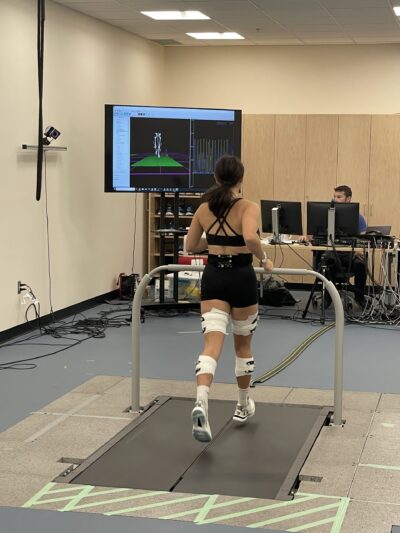
Dr. Napier shares, “The MotionMonitor has been a central component of our workflow in the SFU Run Lab, allowing us to efficiently process and analyse complex biomechanical data across multiple data streams, including motion capture, force plates/instrumented treadmill, and EMG. Its speed and ability to generate clear, high-quality visualizations make it particularly effective for moving quickly from data collection to analysis and interpretation. This has been especially valuable for student training, where efficient workflows help support skill development in biomechanical analysis. We have also found the real-time visualization capabilities to be useful in both research and applied settings, enabling immediate feedback and more dynamic testing protocols. Overall, it has provided a reliable and adaptable platform that supports both high-level research and practical implementation.”
From Motion Data to Meaningful Insight
Using The MotionMonitor, Dr. Napier and his team transform raw motion capture data into actionable insights for performance enhancement, footwear evaluation, and injury prevention. The ability to visualize, quantify, and model movement in detail supports the Run Lab’s mission to improve how runners train, recover, and perform.
Through its use of The MotionMonitor, the SFU Run Lab exemplifies how advanced motion capture technology can drive impactful, translational research — turning complex movement data into knowledge that benefits athletes, clinicians, and researchers alike.
To learn more about SFU Run Lab check out their website: https://www.sfu.ca/run-lab.html. We look forward to supporting the SFU Run Lab as they continue to grow..